Colonial shoot-on-sight and dispersal policy
The Drover's WifeThe Colonial shoot-on-sight and dispersal policy names a system of settler coercion that the novel presents as both a threat of immediate killing and a broader program of removing Aboriginal people from Country. Its force lies not only in weapons or patrols but in the official and everyday language that makes Indigenous presence seem obstructive, and coercion seem like public order. The same logic underpins plans to clear land, the treatment of a wanted Aboriginal man, and a judge’s authorization to remove children classified by their ancestry.
Land, settlement, and the language of dispersal
The policy emerges against the expansion of white settlement into Ngarigo Country. The novel describes settlers taking land, fencing it, and driving Aboriginal people from their homelands, disrupting their ability to move with the seasons. The result is a life organized around survival and concealment. It presents the asserted right to shoot any Aboriginal person on sight as a justification for eradicating or dispersing people portrayed by settlers as an obstacle to nation-building.
Charles Edwards gives this project a local political program. A regular participant in district meetings, he proposes that Cresthill be developed into a town because a major stock route passes through and more farmers and settlers are arriving. He offers to help finance the development but insists that Aboriginal people need to be managed. The settlement plan and the language of management are joined: making the district available to settlers depends on displacing its original inhabitants.
The policy’s administrative vocabulary obscures its violence. The term dispersal makes expulsion sound like a practical measure, while the claim that Indigenous people slow progress recasts the taking of land as an answer to inconvenience. The novel shows the material consequences behind those terms: loss of homeland, restricted movement, arrest, imprisonment, and the possibility of being shot without protection from the law.
Enforcement and everyday threat
For the wanted Yadaka, this system is not an abstraction. When Molly Johnson worries that his presence could bring troopers to her doorstep, she also knows that Aboriginal people in the district are blamed for everything and that many have already been arrested, imprisoned, or driven away. Yadaka explains his iron collar through the injustice of being punished simply for existing as a Black man. The exchange makes the policy’s racial premise personal: his identity itself places him in danger, regardless of any account of his actions.
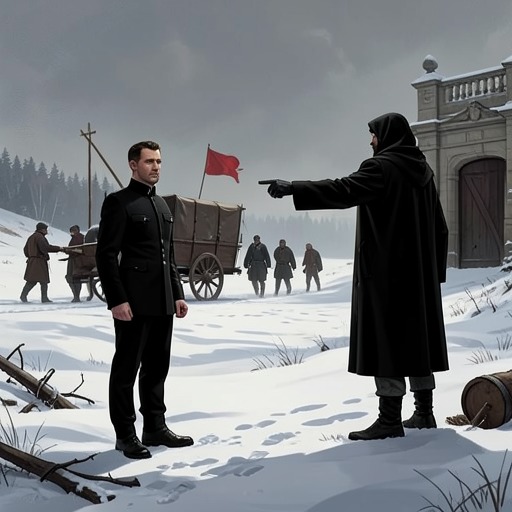
The novel also depicts the policy as an accepted assumption among local officials. While preparing for his work, Nate Clintoff reads a statement that calls Aboriginal people a nuisance to settlers and livestock and declares that assistance in clearing their way should be guaranteed. Spencer Leslie proposes a raiding party, anticipating that local people will otherwise attack Aboriginal women and children. When Nate objects that innocent people will die, Leslie answers by excluding Aboriginal people from the category of innocence. The exchange reveals how official planning can authorize violence by first denying its intended victims equal moral standing.
Leslie’s account of the patrol route further exposes the gap between nominal responsibility and protection. He says Molly will be checked on, but that the troopers will take two days to reach her even if they leave immediately; he then treats their responsibility for her welfare as finished. The timetable makes abandonment sound procedural. A system that promises oversight can leave people exposed while defining its limited intervention as sufficient.
From racial classification to child removal
The policy’s logic extends beyond armed enforcement into the classification and custody of children. At a hearing, Miss Shirley identifies Black Mary as Charles Edwards’s daughter, describes Molly as harboring a wanted Aboriginal man, and labels Molly’s children octaroons while urging that they need help. Judge Eisenmangher authorizes their removal for their safety. The protective wording masks a decision made without the children’s or their mother’s consent, converting racial identification into grounds for state separation.
Danny learns the label from Miss Shirley and asks Molly what it means. Molly recognizes the danger because, as a child, she heard Miss Shirley discuss sending her away as a mixed-heritage child. That memory joins the present order to an earlier threat: classification can make a child removable while withholding the truth from the child and family. The scene shows how bureaucratic power acts through names as well as force, and how a declaration of welfare can conceal an attack on family bonds.
Molly responds by tying up Miss Shirley and Father McGuinness, taking the signed authorization, and burning it. She then prepares blankets and food for her children and leaves with them. Her action prevents the order from being carried out at that moment, but it does not undo the legal and racial power that produced it. The burning paper makes the conflict tangible: a state document claims authority over the family, while Molly rejects its claim through direct action.
Narrative significance
The policy links land seizure, policing, and child removal as connected exercises of colonial authority. It determines who may remain on Country, whose movement is treated as a threat, and which families can be separated in the name of protection. The novel distinguishes the official language of law and welfare from the coercive outcomes it enables, while showing that local officials, settlers, and institutions can reproduce the same assumptions in different forms.
The novel’s account also places this fictional history beside the author’s reflection on government policies that prevented the transmission of Aboriginal culture through her family. That connection grounds the story’s concern with removal and cultural loss without collapsing the novel’s 1893 events into a later historical period. Across both the immediate danger to Yadaka and the threat to Molly’s children, the policy’s central consequence is the attempt to make Aboriginal presence and kinship subject to settler control.